Why Smart Route Planning Is One of the Most Undervalued Investments in Distribution
The Morning Scramble Nobody Talks About
In distribution businesses across the UK, every working day begins the same way. A planner — or in smaller operations, the depot manager — sits down with a list of deliveries, a spreadsheet, and years of hard-won local knowledge. They work through it manually: who is available today, which vehicles are roadworthy, roughly which areas make sense to cluster together, roughly how long each run should take.
By the time drivers are briefed and loaded, assumptions have already been baked in. Assumptions about travel times that were right in 2019 but don't account for a new bypass. Assumptions about delivery durations that ignore the fact that one customer always needs a full offload. Assumptions about which driver knows which route — assumptions that collapse the moment someone calls in sick.
This is not a criticism of the people doing this work. It is a structural problem. Manual route planning is inherently limited by how much a human brain can optimise across dozens of interdependent variables simultaneously. And that limitation has a measurable cost.
What Poor Planning Actually Costs
The costs of suboptimal route planning are rarely measured directly — which is exactly why they persist. They show up instead as:
- •Excessive mileage — routes that backtrack, overlap, or take longer roads when shorter ones exist
- •Overtime — drivers running past their contracted hours because the plan assumed too much
- •Missed deliveries — stops dropped when a run over-runs, generating re-delivery costs and damaged customer relationships
- •Fuel waste — every unnecessary mile burns money and impacts your carbon footprint
- •Driver dissatisfaction — poorly planned days where one driver finishes at 15:30 and another is still on the road at 18:00 breed resentment and attrition
- •Reactive replanning — when circumstances change mid-day, manual plans fall apart. There is no quick way to rebalance
A distribution company running six vehicles across 30 daily stops, operating 250 days per year, can easily accumulate tens of thousands of pounds in avoidable costs annually from mileage inefficiency alone. When you add overtime, re-deliveries, and the hidden cost of planner time, the number grows significantly.
The Off-the-Shelf Software Trap
Many distribution businesses have attempted to solve this with route optimisation software. Some of those implementations have worked well. Many have not — and the reason is almost always the same: generic software optimises for generic businesses.
Off-the-shelf route planners are built around a lowest-common-denominator configuration. They may not understand your specific depot layout, your customer-facing delivery windows, your vehicle capacity mix, or the operational rules your business runs on. They offer configuration options, but those options rarely map cleanly onto the way your operation actually works.
The result is software that the planning team works around rather than with. Routes get exported, manually adjusted, and re-imported. The tool becomes a cost centre rather than a capability.
A Platform Built Around Your Business
Our fleet planning platform is custom-built from the ground up — and that distinction matters more than it might initially appear. Rather than adapting your operation to fit a software template, the software is designed to encode your specific operational rules, constraints, and preferences.
That means when your business has requirements that no off-the-shelf system anticipated — an unusual shift structure, a customer with specific time windows, a vehicle that can only take certain load types — those requirements can be built in precisely, not approximated.
The platform is built to grow with your operation. New rules, new constraints, new vehicle types, new depot locations: these are configuration changes, not product change requests submitted to a vendor.
What the Platform Plans For
The diagram above shows a single driver's day as the platform plans it — not as a loose sequence of stops, but as a structured, minute-level schedule that accounts for every element of a working shift.
Daily Vehicle Safety Checks
Before any driver turns a wheel, the platform allocates time for the pre-departure vehicle safety check mandated by operator licence requirements. This is not an afterthought — it is baked into the schedule as the first block of every driver's day. If your safety check procedure takes 20 minutes, the plan reflects 20 minutes. The first delivery time is calculated from when the vehicle is actually clear to depart, not from when the driver clocks on.
This matters for compliance, and it matters for accuracy. A schedule that ignores pre-departure time is a schedule that will run late.
Realistic Drive Times from Real Road Data
Rather than estimating drive times using straight-line distances or crude averages, the platform queries live road network data via the same routing infrastructure that powers professional navigation systems. Every drive leg in the schedule reflects actual road distance and realistic travel time — accounting for the road network between point A and point B, not a crow-flies approximation multiplied by a fudge factor.
When the plan says a driver will arrive at their second stop at 10:47, that figure is grounded in road reality, not optimistic estimation.
Intelligent Lunch Break Scheduling
The platform applies a straightforward but often-missed rule: drivers working a full shift are entitled to a rest break, and that break needs to appear in the schedule at the right point — not as an afterthought at the end. Lunch is automatically inserted once the driver reaches a configurable point in their day (typically midday), without disrupting the flow of deliveries around it.
Importantly, the platform also recognises when a break is not required. A driver completing a short run and returning to depot before midday will not have an unnecessary lunch break inserted into their schedule. The rule is applied intelligently, not mechanically.
Hard Shift Caps and Overtime Protection
Every driver's schedule is bound by a configurable shift cap — a maximum working day beyond which no further stops will be assigned. When a run approaches the limit, the platform does not squeeze in one more stop optimistically. It stops, flags the remaining delivery, and routes it to another vehicle or marks it for a separate run.
This is one of the most commercially significant constraints in the system. Overtime is expensive. Fatigued driving is dangerous. A platform that respects shift limits — and enforces them automatically — protects both your cost base and your duty of care.
Mileage-Balanced Vehicle Assignment
The platform does not simply assign stops to vehicles arbitrarily. It uses a sweep-angle clustering algorithm to group deliveries into logical geographic zones, and then balances total mileage across all active vehicles so no single driver carries a disproportionate load. Subsequent rebalancing passes check whether shifting individual stops between vehicles would reduce overall shift time without adding significant mileage — and make those adjustments automatically.
The result is a schedule where all drivers finish within a reasonable window of each other, reducing overtime and improving fairness across the team.
Overflow Detection
When demand exceeds what the active vehicle fleet can handle within shift constraints, the platform surfaces this clearly rather than silently compromising the plan. Unassigned deliveries are flagged as overflow, additional vehicles can be activated from a pre-configured reserve, and planners are given a transparent view of exactly which stops require attention and why.
There are no silent failures. The plan you see is the plan that can actually be executed.
Drag-and-Drop Manual Control
AI optimisation is the starting point, not the end point. Experienced planners carry knowledge that no algorithm can fully encode — a particular customer who always needs extra time, a vehicle that should not go to a certain area, a driver with specialist knowledge of a specific route. The platform surfaces these adjustments as a first-class capability.
Every delivery in the schedule can be manually reassigned between vehicles using drag-and-drop. When a reassignment is made, the schedule recalculates instantly: drive times update, shift totals recalculate, and the overall plan reflects the new arrangement in real time. The platform accommodates human judgment without discarding algorithmic intelligence.
Live Road Map
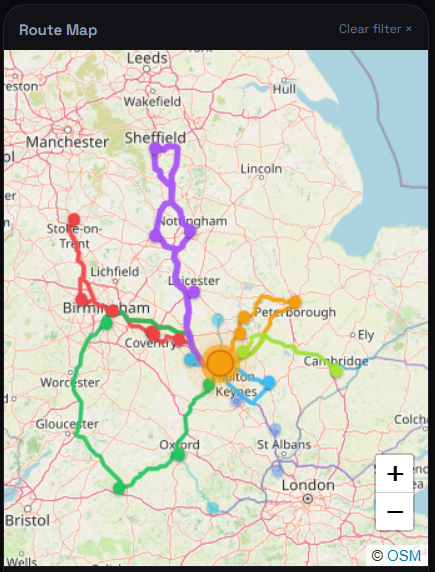
Every planned route is rendered on an interactive road map showing the precise path each vehicle will take — not a straight line between stops, but the actual road geometry. Planners can see at a glance whether routes make geographic sense, identify any obvious inefficiencies, and get a visual confirmation that the plan holds together before drivers are briefed.
Business Benefits
A well-implemented fleet planning platform delivers measurable improvements across several dimensions:
- •Reduced mileage — AI-optimised routes consistently outperform manual planning on total distance driven
- •On-time delivery rates — schedules grounded in real road data perform closer to plan
- •Overtime elimination — hard shift caps enforced at planning stage mean overtime becomes the exception rather than the rule
- •Planner time savings — a process that previously took 45 minutes each morning can be completed in under two minutes
- •Compliance confidence — vehicle checks and shift limits are documented in the plan, supporting operator licence obligations
- •Driver fairness — balanced workloads reduce friction and support retention in a sector where driver turnover is costly
Every Business Is Different
There is no universal fleet planning solution because there is no universal fleet. A pharmaceutical distributor with cold-chain vehicles and time-critical delivery windows has fundamentally different requirements to a parts supplier running a fixed-stop daily circuit. A business with a single depot faces different constraints to one with regional hubs and inter-depot transfers.
The platform described here is a demonstration of capability — not a fixed product. Every constraint, every rule, every schedule parameter can be adjusted to reflect the way your operation actually runs. If your business has requirements that do not fit a standard template, that is precisely the kind of problem a bespoke platform is designed to solve.
See It in Action
The best way to understand what this kind of planning platform can do for your operation is to experience it directly. Our interactive demo uses a realistic distribution scenario — a single depot in Northampton, six vehicles, and 30 deliveries across UK car dealerships — to show every feature described above working in real time.
Explore the Fleet Route Planner demo →
You can run the automatic optimisation, inspect every driver's schedule in detail, drag and drop deliveries between vehicles, and watch the live road map update. No login required.
Want to explore how this applies to your organisation?
Get In Touch